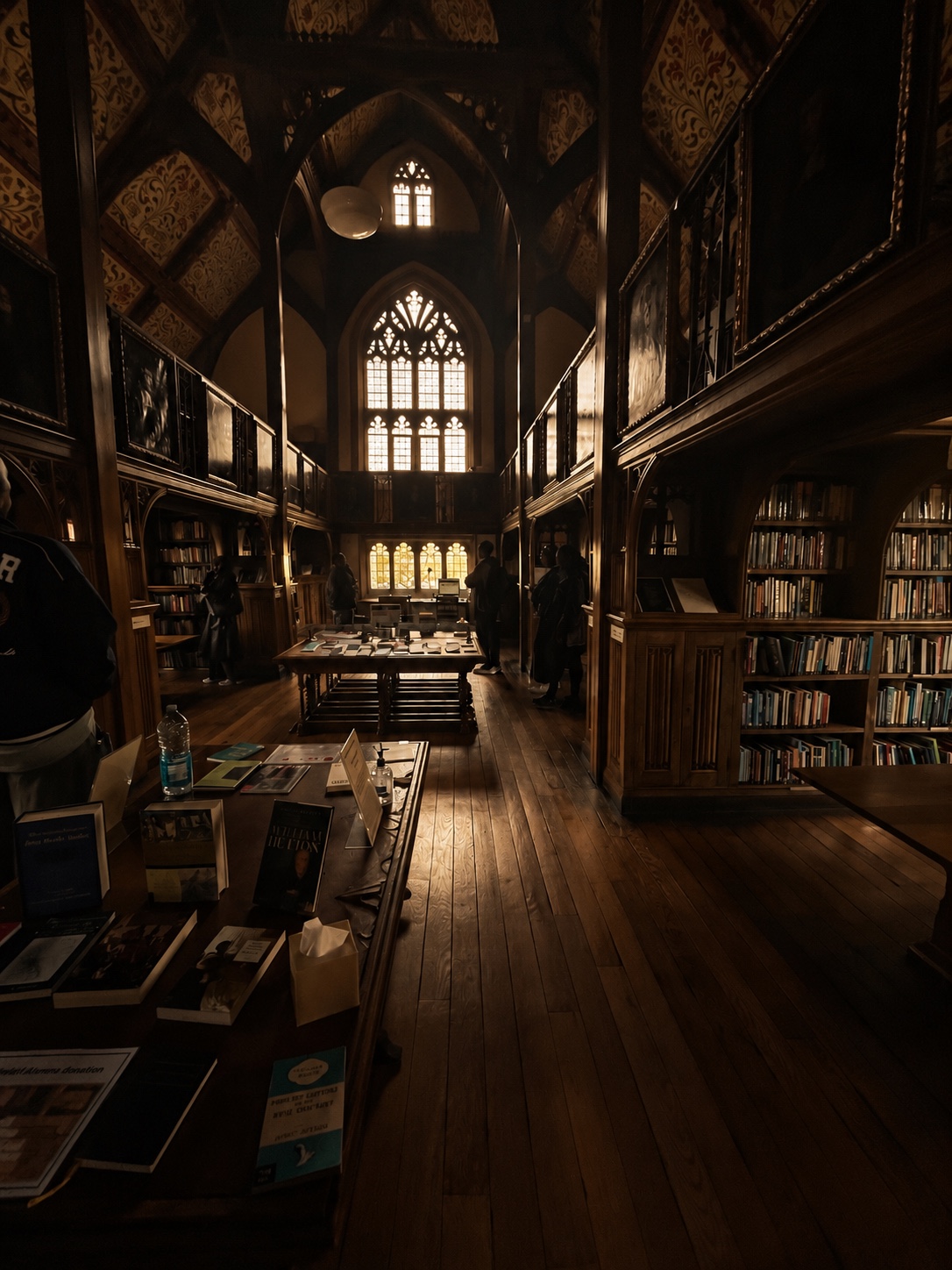
reading room ୨୧
what stays on the desk.
Books, reports and research for thinking more carefully about politics.
A photograph I took at one of the University of Cambridge libraries.
reading room · 10 Nov 2026
Alex Keyssar on why America still chooses its presidents through the Electoral College, even though people have been arguing about changing it for more than two centuries.
read note →reading room · 7 Nov 2026
Angela Davis asks whether prison is really the obvious answer to crime. I'm not entirely convinced by abolition, but I'm interested in why we treat the prison system as inevitable.
read note →reading room · 1 Nov 2026
I worked for my grammar school place. I also know children don't begin with the same advantages. Michael Sandel has a rather uncomfortable question about what success proves.
read note →reading room · 25 Oct 2026
Walter McMillian was sentenced to die for a murder he did not commit. Bryan Stevenson's account made me think about what the death penalty asks us to trust.
read note →reading room · 17 Oct 2026
David Lammy's report asks why racial disparities persist across the criminal justice system, and why publishing the numbers is only the start.
read note →reading room · 15 Oct 2026
Jonathan Haidt's argument about intuition and moral judgement helps explain why political debates so often turn into people talking past each other.
read note →reading room · 27 Sept 2026
The Shamima Begum case exposes a difficult constitutional question: when national security and citizenship collide, how much discretion should the Home Secretary have?
read note →reading room · 29 Aug 2026
The criminal justice system can promise rights it struggles to deliver. What The Secret Barrister reveals about the distance between legal principle and institutional reality.
read note →reading room · 19 Aug 2026
How Stanley Cohen's concept of moral panic helps explain the political construction of threatening groups, and why we should check the figures before panicking.
read note →